Abstract
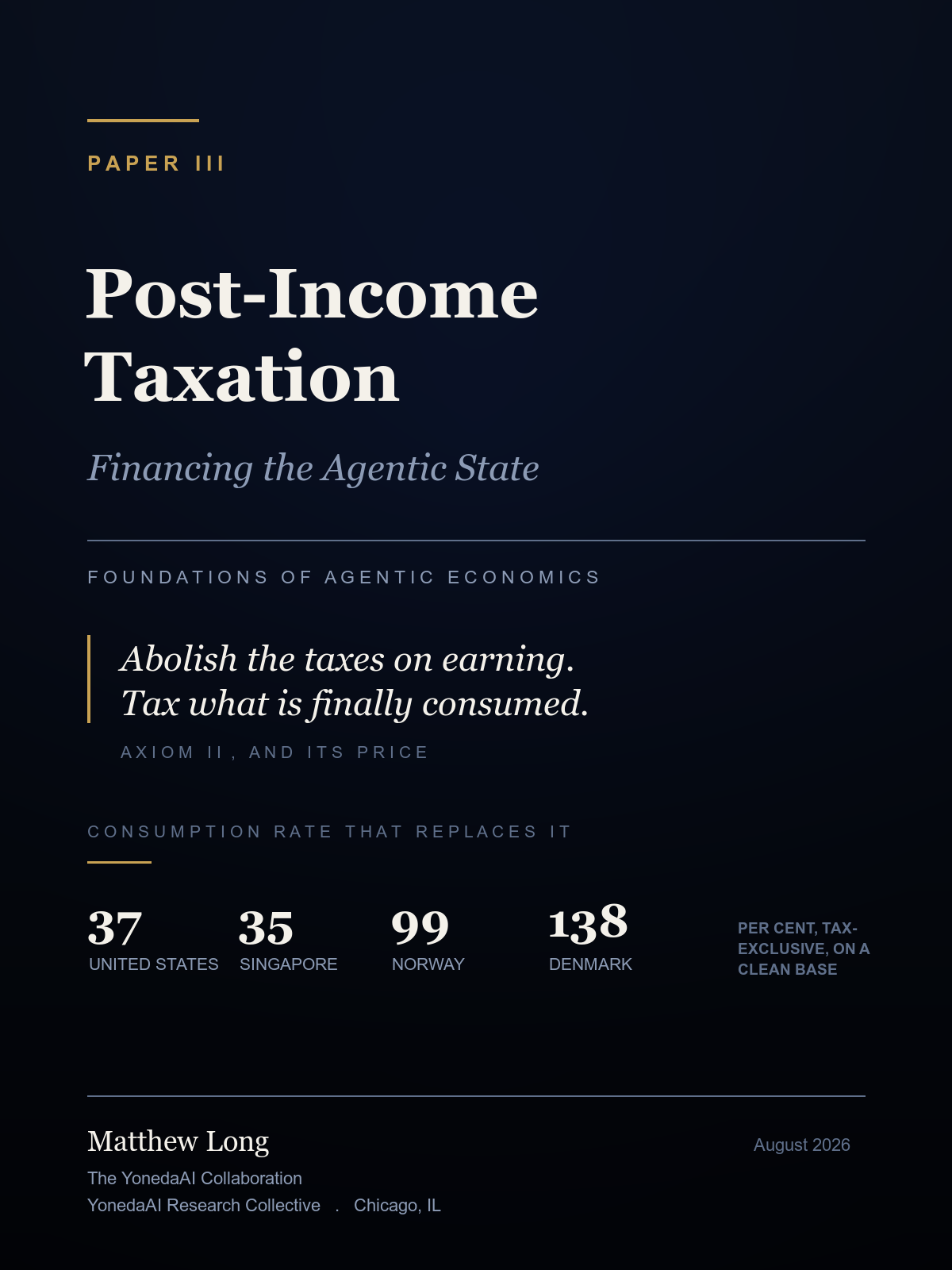
Papers I and II of this series argued that the primitive object of an economy is the obligation rather than money, and that autonomous agents can produce, contract and settle as economic principals. This paper sets out the fiscal consequence and argues for it: taxes on labour and productive income should be abolished, and the revenue replaced primarily by a broad tax on final consumption, with scarcity rents and the return on public capital as supplements rather than as the main instrument. The case for abolition rests on two things this paper can show rather than assert. Income taxation is collected from wage earners with a completeness it never achieves against income that can be retained inside an entity, deferred, or converted into capital gain, because the third-party withholding that makes labour income administrable also leaves its holders no margin of avoidance. That is a claim about compliance and avoidance opportunity, not about economic incidence, which depends on price adjustments this paper does not model. And under agentic production the base itself becomes ambiguous, since an agent netting obligations against counterparties may never realise anything a twentieth-century code would recognise as receipts. We then compute the replacement, honestly and per country, and report the rate the arithmetic actually requires rather than the rate an advocate would prefer. Assuming coverage of 96 per cent of the household consumption base, abolishing all taxes on labour income, corporate profit and social insurance in the United States requires a consumption tax of 37.2 per cent tax-exclusive, equivalently 27.1 per cent tax-inclusive. At the OECD-average coverage of 58 per cent it is 61.7 and 38.1. Adding a universal rebate on subsistence consumption raises the first pair to 46.6 and 31.8 per cent. Denmark cannot do this: replacing its productive-income gap together with all existing goods-and-services taxation means a rate of 138.1 per cent tax-exclusive, or 113.1 at Denmark's own current coverage. Norway and Singapore sit between. The public capital endowment, which earlier framings of this argument treat as a precondition, is better understood as a rate reduction, and a bounded one: a fund of one times GDP drawn at 4 per cent lowers the required American rate from 37.2 to 30.7 per cent, and two times GDP to 24.2. The endowment buys a lower rate, not the end of consumption taxation.
Key equations
The abolition target
Two ways of quoting the same tax
The replacement architecture
The endowment equivalence