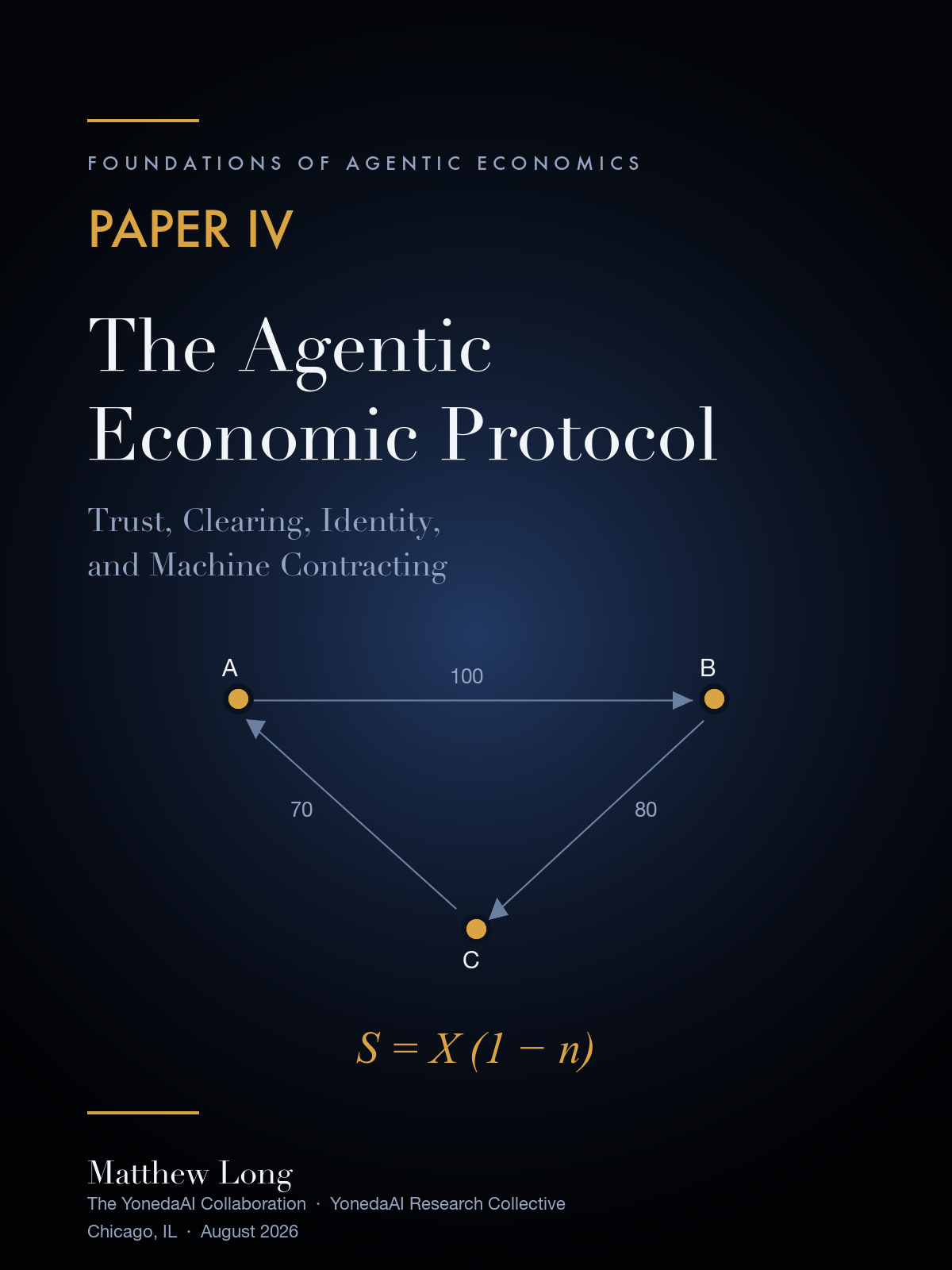
The Agentic Economic Protocol
Trust, Clearing, Identity, and Machine Contracting
Abstract
Papers I–III of this series argue that the obligation is the economic primitive, that autonomous systems can hold balance sheets and produce, and that a state can be financed without treating production as a taxable event. This paper specifies the machinery those arguments presuppose: a protocol with a cryptographically verifiable economic identity carrying capabilities, authorization, obligations, assets, reputation, guarantees and settlement history; a machine-readable contract object; and a clearing layer in which gross exchange requires settlement of only the residual after netting. The identity and contract constructions are grounded in W3C Decentralized Identifiers and Verifiable Credentials and in the agent-payment protocols that appeared during 2025. The binding constraints are legal and institutional, not computational. Netting cancels transit along chains as well as circulation, so deeply disaggregated machine production raises the nettable proportion instead of lowering it — but fragmenting a netting set weakly raises total settlement, which is where the fragility of the design lives. The protocol's hardest unsolved problem is not verifying computation but verifying the world. The paper closes with a restriction that Paper V constitutionalizes: artificial intelligence may optimize the protocol; it does not hold unlimited sovereign authority over it.
Key equations
Machine-readable contract object
Settlement compression
The netting bound, in cycle share and mean path length
The essential restriction