The Agentic Production Economy
Intelligence, Capital, and Autonomous Enterprise
Abstract
Paper I of this series treats the obligation as the primitive economic object and money as the residual left over after clearing. This paper asks what changes when some of the nodes in that obligation graph are artificial agents that produce, contract, and settle on their own account. The answer is deliberately narrow, because the broad version of the claim is wrong. The novelty is not in the production function: an artificial intelligence that merely produces is capital, and the existing literature on automation already describes it well. The novelty is in the location of the contracting node — a machine that is a factor input cannot issue an obligation; an agent whose forward output can be underwritten can. The series' production decomposition is shown to be, as a statement about technology, the perfect-substitutes upper envelope of the constant-elasticity family, and so overstates achievable output whenever inputs are complements. Economic capacity is given an operational definition as the largest obligation stock an agent can credibly carry, replacing the budget constraint as the binding restriction on agent behavior. The Agentic Enterprise is developed as an organizational form: cheap machine negotiation does not dissolve the firm, it relocates the firm's boundary from communication cost to verification and underwriting cost. Four objections are treated at length: reliability failure that does not diversify away because agents share model lineage, the Minskyan instability of lending against projected machine output, the absence of legal standing for an agent balance sheet, and the concentration risk created when a small number of model providers hold what amounts to an undisclosed senior claim on every dependent agent's production.
Key equations
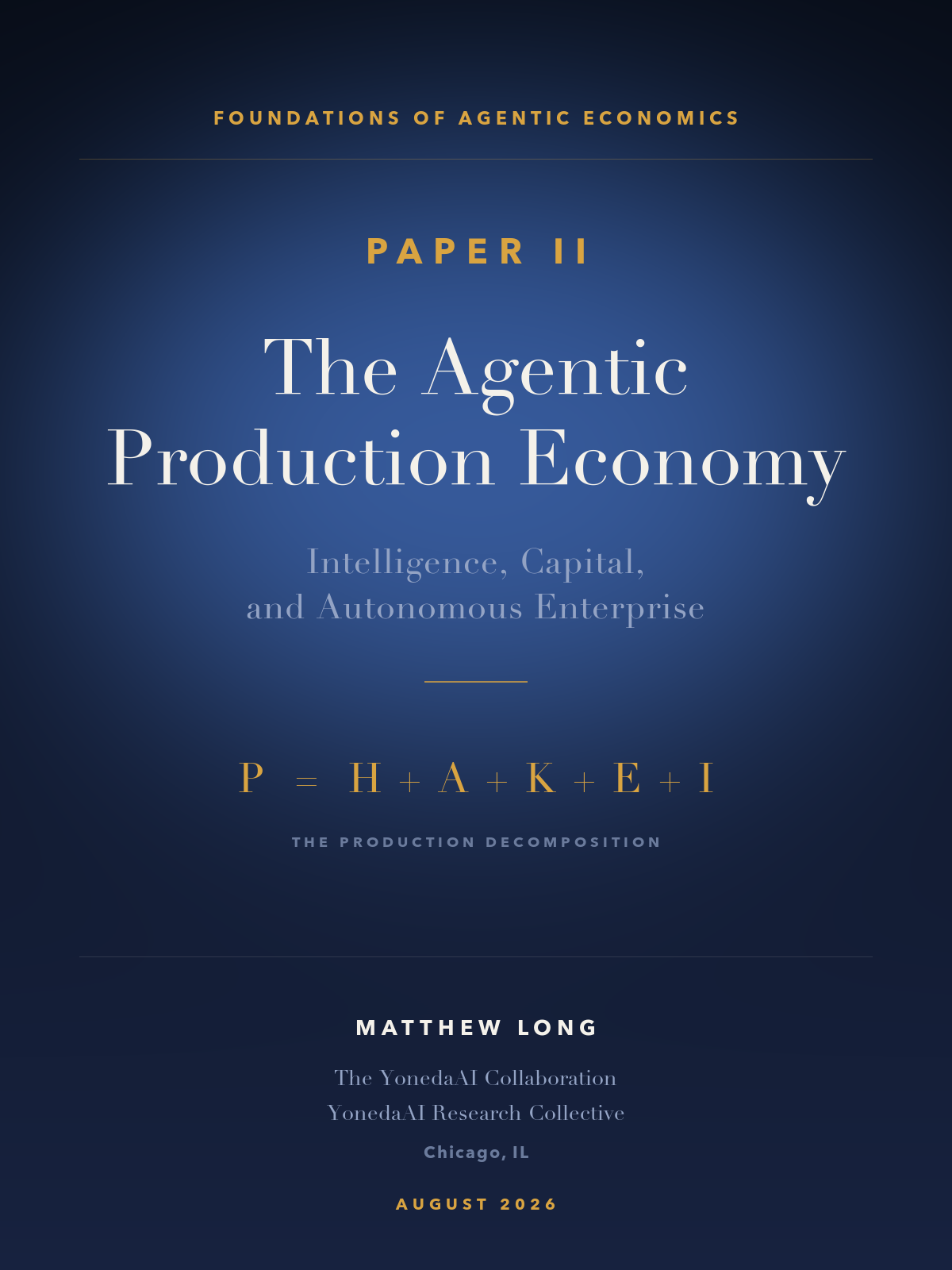
The production decomposition (and its upper-envelope reading)
Economic capacity replaces the budget constraint
Continuously revalued credit limit
The evolution of the economic unit