Abstract
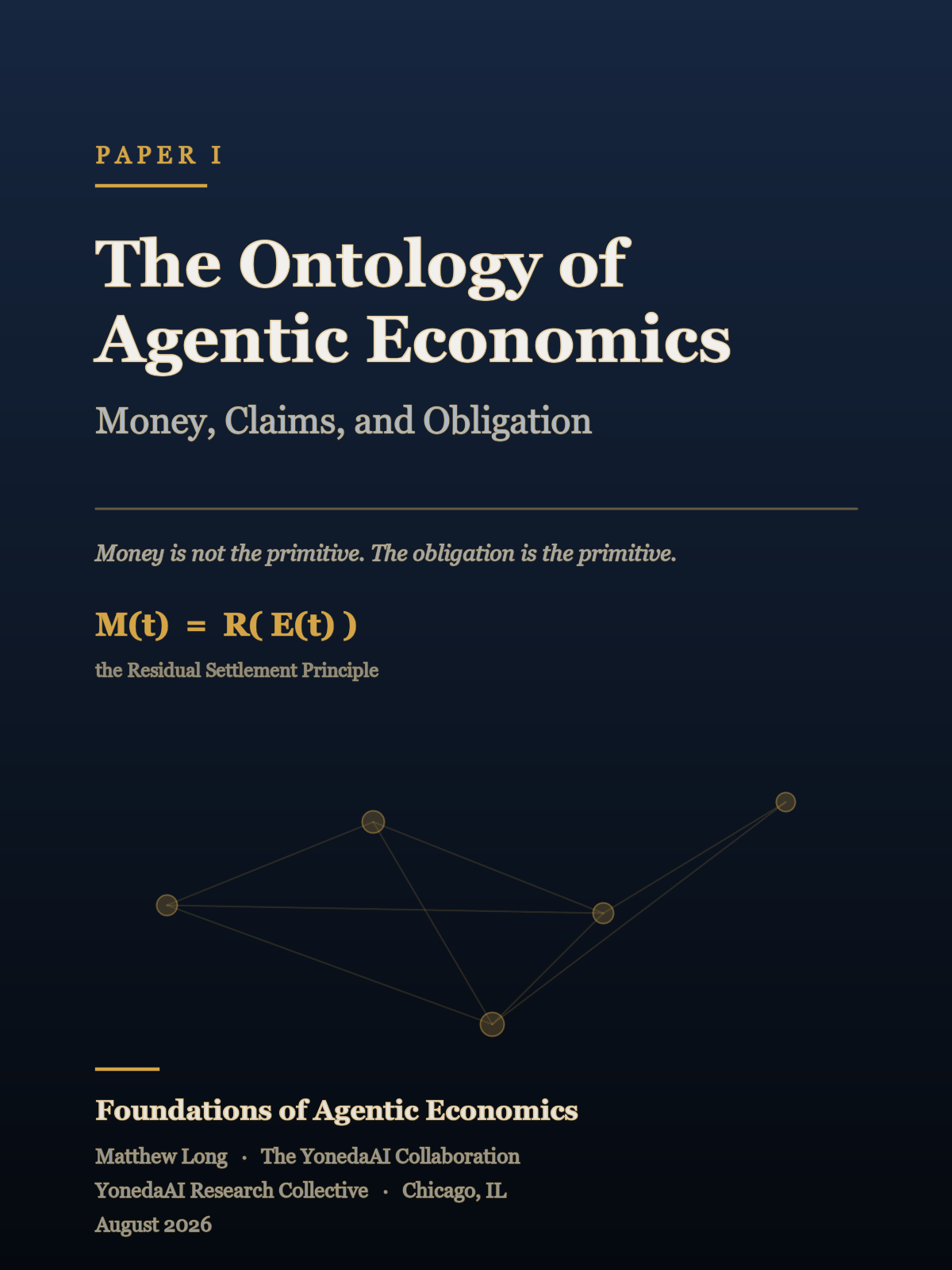
Monetary theory has spent two centuries arguing about what money is, and the argument has been hard to settle because the competing answers explain different things. This paper proposes an ontology in which the disagreement partly dissolves. The primitive economic object is not money but the obligation: a directed, dated, conditional promise running from one party to another. An economy is then a time-dependent directed graph whose vertices are humans, firms, governments, machines, and AI agents, and whose edges carry a quantity, a unit of account, a maturity, a set of conditions, and a risk. Money appears late in this construction rather than early, as the standardized and highly transferable claim used to discharge whatever survives clearing. We state that idea as the Residual Settlement Principle and give it analytic content by proving four results about the clearing operator, modeled as a partition of obligations into netting groups: gross compression is settlement-neutral; coarsening the partition weakly reduces the settlement requirement, so multilateral netting dominates bilateral netting, which dominates gross settlement; no arrangement drives the requirement to zero unless the graph is balanced at every vertex, which is non-generic; and shortening the settlement window is a refinement that weakly increases the requirement. Existing infrastructure demonstrates the effect at scale: CLS settles trillions of dollars daily against funding of well under one percent of that value. Autonomous agents matter here for two reasons, neither of which is speed: they lower the reconciliation cost that bounds how wide a netting perimeter can be, and cheap machine verification enlarges the set of contracts that can exist at all. The framework is offered as a research program rather than a finished theory.
Key equations
The economy as a time-dependent obligation graph
The Residual Settlement Principle
Money redefined
Every asset is somebody else's liability